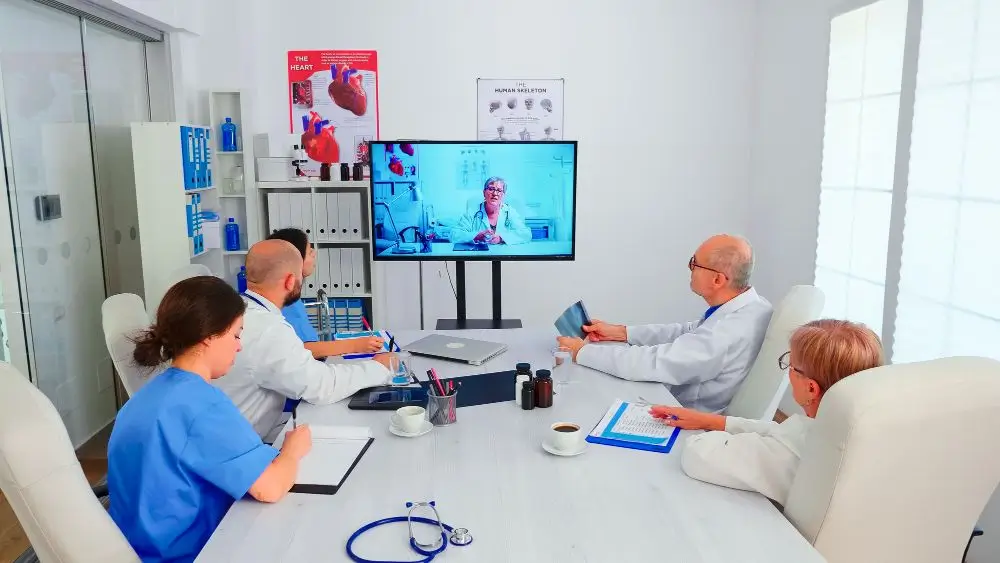
Healthcare facilities cannot base their staffing levels on a fixed monthly decision, like other industries.
Census surges, maternal leaves, minimum staffing requirements, and limited access to qualified clinicians force medical centers to adopt flexible healthcare staffing models that adapt to every situation.
Effective healthcare workforce planning requires a stable core workforce, combined with internal float pools, travel nursing contracts, and per diem clinicians to respond to unpredictable situations that may arise daily.
Understanding this hybrid approach can help leaders in healthcare and other labor sectors make more cost-effective staffing decisions.
Why the Healthcare Staffing Model Is Different
In this context, hybrid staffing has nothing to do with remote versus in-person work. It refers to blending permanent healthcare staff with several tiers of contingent workforce, each one absorbing a different kind of demand swing.
Three conditions push healthcare toward this model harder than most industries.
Regular Fluctuations in Labor Demand
Average daily census, the typical number of patients a facility treats on a given day, can shift within hours. A single flu outbreak, a mass casualty event, or a slow holiday weekend changes staffing needs long before a manager can adjust headcount through normal hiring.
Labor Supply Is License-Gated
A facility cannot widen its hiring funnel with a job posting and a two-day induction. Every clinician needs an active license, and the qualified population within a given radius is finite, verifiable, and slow to grow. That constraint shapes healthcare labor demand forecasting far more than it shapes retail or hospitality staffing.
Labor Minimums Are Often Regulated
In several states, the nurse-to-patient ratio is not a best practice; it is law. Minimum staffing levels are a statutory floor, not a target to manage down during a quiet quarter, which removes a lever that most industries still have available.
The Problem Every Scheduled-Labor Industry Shares
Strip away the licensing and the regulation, and healthcare’s core challenge is one that retail, warehousing, hospitality, and contact centers all recognize.
Demand Varies More Than Headcount Does
Retail swings week to week. Warehousing swings by season. Hospitality swings day to day, and contact centers swing hour to hour. Headcount, meanwhile, is set on a near-monthly cycle and moves slowly in either direction.
Two Failure Modes, Only One Gets Measured
Understaffing is visible right away: missed service levels, unplanned overtime, and frustrated customers or patients. Most organizations are quick to notice when they don’t have enough staff, but they rarely track when they have too much, until it shows up as a budget overrun months later.
Default Responses Are Blunt Instruments
Facing a demand spike, most organizations reach for one of three tools:
- Mass seasonal hiring: Expensive to recruit for, expensive to release from, and uncertain in quality
- Mandatory overtime: Cheap on the timesheet today, but costly in attrition and error rates later
- Spot agency buys: The fastest option and usually the priciest, with the least accountability once the shift is filled
How Healthcare Facilities Meet Staffing Needs
Facilities need to know not only how to meet long-term staffing needs but also how to fill open nursing shifts quickly.
Rather than choosing one blunt instrument, healthcare organizations typically layer several tiers of labor, each sized for a different kind of variation:
- Core staff: Sized to typical demand, covering the baseline census that a facility can predict with confidence
- Internal float pool: Provides flexible coverage from staff who already work for the organization, moving between units as census shifts
- Travel nursing contracts: Fill extended gaps, such as a leave of absence or a unit expansion that will last months rather than days
- Per diem nurse staffing: Covers the unpredictable, shift-by-shift swings that no fixed schedule can anticipate
The float pool vs. per diem staffing distinction matters here.
A float pool draws from employees the facility already trained and vetted, while per diem staffing reaches outside that pool to independent clinicians who pick up shifts as they become available.
Facilities usually turn to per diem coverage once the float pool is exhausted, since it costs more per shift but requires no long-term commitment. That trade-off is also its advantage: per diem staffing gives facilities access to a much larger pool of qualified clinicians than an internal float pool can offer, and it lets a facility scale coverage up or down instantly without carrying any fixed labor cost once the shift ends.
Most facilities blend all four tiers into a hybrid staffing model rather than relying on any single one, and they track a core-to-flex staffing ratio to keep the mix intentional rather than reactive. Schedulers and staffing leaders increasingly use a workforce management platform like Nursa to manage this blend, giving facilities the visibility into what staffing gaps they have and tap into as-needed shift coverage and recruiting options, without the overhead of running each tier through a separate system.
What Can Be Learned from This Model?
The tiering itself is useful, but the discipline behind it is what translates most directly to other industries.
1. Size to the True Demand, Not the Average
Staffing to the mean guarantees being wrong in both directions. The method starts with 12 months of daily volume data: find the floor, median, and 90th percentile. The floor sizes the core staff, and the gap between the floor and the 90th percentile is the flex requirement.
2. Tier Your Flex by the Kind of Variation It Absorbs
Predictable and unpredictable variation need structurally different answers. Most organizations own exactly one flex tier and use it for everything, which is why that tier ends up simultaneously too slow for emergencies and too expensive for routine swings.
The study “Cost Outcomes of Supplemental Nurse Staffing in a Large Medical Center” examined 19 units and found that the modest use of supplemental nurses was cost-efficient. In addition, the study didn’t find a statistically significant difference in hourly personnel costs between using supplemental nurses and overtime worked by permanent staff.
3. Build a Pool of On-Retain Talent
A recruiting pipeline is people moving toward a role. A pool is people who are already qualified and already available. The second shortens time-to-fill in a way a pipeline never can, because there is no vetting or onboarding step standing between the vacancy and the shift.
This distinction is also where most organizations find how to reduce agency staffing costs. Spot agency buys are expensive precisely because they start from zero: no existing relationship, no pre-verified credentials, and no history with the facility. A retained pool skips all of that, which is why it usually costs less per shift even when the posted pay rate looks similar.
Building the pool is only half the work; keeping it engaged is the other half. Facilities that do this well watch two figures closely. Premium pay and overtime spend tend to fall as the pool grows, since fewer gaps need mandatory overtime or last-minute agency calls to fill. Labor cost per worked hour tends to fall as well, since pool labor is priced lower than emergency coverage even when it fills the exact same shift.
The same logic holds outside healthcare. A retail chain might keep a roster of former seasonal employees on call. A warehouse might maintain a list of trained temporary workers it can recall on short notice. Both are solving the same problem: how to fill open shifts fast. These strategies get qualified labor back into the building quickly, without paying the premium that comes with starting a search from nothing.
A tiered staffing strategy can work across different labor-intensive industries such as retail, warehousing, hospitality, and contact centers. Since demand fluctuates in these industries, they can’t rely only on their core workforce. Building a strong hybrid staffing model can reduce dependence on overtime and premium pay and enable more efficient responses to staffing gaps.